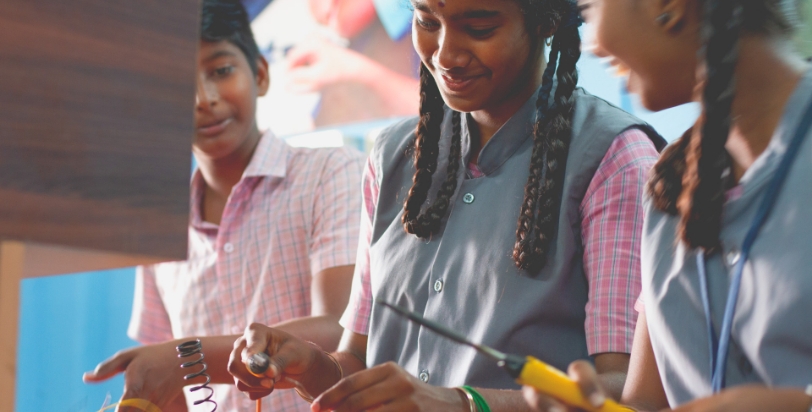
Driving the digital vision forward, Capgemini has been striving towards the betterment of society using the confluence of technology and innovation to unearth the deep roots of inequality that has been, for generations, pulling the marginalised classes into the clutches of poverty, and ushering in a new life, a new beginning, with hopes and aspirations. From empowering underserved communities through education and employment to addressing environmental and climate change challenges, the commitment to the welfare of society runs deep in the veins of Capgemini’s CSR initiatives.
The pioneering work by Digital Academy has its foundation in leveraging technology to build sustainable livelihoods amongst marginalised communities, those that do not necessarily have the resources or the opportunities to break away from the societal barriers impeding their growth and development. The ultimate goal is liberation from a life curbed by socio-economic constraints, from a life trapped in the vicious cycle of poverty to one where they may soar at the heights of their dreams, becoming wings of triumph and change in their communities.


Capgemini’s Digital Academy began in 2016 as a livelihood and career development programme dedicated to serving communities that often face neglect. As the wheels of time saw our society rapidly progress into the digital age, there came a pressing need to address the growing digital divide that was becoming prevalent in our country. Several sections of the population, especially from rural and economically disadvantaged backgrounds, found themselves in dire straits as lack of digital literacy meant that they were now unable to access essential resources such as healthcare, banking, employment, or even stay informed with the advancements of the world.
Adding another dimension to the problem was increasing unemployment among educated youth, who could not embark on their career paths despite completing their formal education. They were under-skilled in the new economy. For Capgemini, it became apparent that the best way to impact communities and drive transformation was by tapping inwards into their expertise and the power of technology to unleash creative potential.

Girish Singhania
Founder & CEO at EduBridge Learning, NGO Partner
“The macro picture behind the Digital Academy is the fact that India currently has more than 65% of its population in the working age group. This happens once in the lifetime of a country. What this translates into is that there are almost 80 to 90 crore people in the working age group, out of which there are almost one crore engineers graduating every year. If you see how many of them actually end up getting productively employed or gainfully employed, the number is very few. It is our responsibility to ensure that we channelise their energies into something more productive because otherwise this entire demographic advantage goes to waste. That’s where the entire concept started, that once they graduate, if we can provide them with the right opportunity, skillset and mindset, then they could get employed.”
Recognising the need to address the critical problems facing our society, in 2018, Capgemini focused on bridging the widening gap between education and employability and inculcating digital skills among underserved communities to open the door to a world of opportunities. The Digital Academy took its shape and form out of this endeavour, of this vision that technology could become a boon in aiding the upliftment of socially and economically marginalised communities. By imparting the necessary training and skills that would help them establish long-lasting careers in the technology sector, the programme aims to facilitate socio-economic mobility and freedom amongst the marginalised classes. These individuals also become role models in their families and communities. Like a butterfly effect, they inspire many others to break out from their cocoons and become agents of transformation.
Drawing on the strengths and the resilient support from its longstanding partnerships with various organisations, the Digital Academy has gained momentum over the years and brought together numerous initiatives under its wings, stretching out to demographics that would otherwise have been left behind, with the sole purpose of enabling meaningful transformation at the individual and community level. Strongly committed to diversity and inclusion in the workforce, the programme impacts a wide range of people and mentors them in critical areas of employment and skill development, ultimately aiding their personal and professional growth.
 “There are multiple target groups that we focus on, but the common thread
is that they are underserved and would otherwise not get these opportunities
on their own. These are the people we want to help the most. For example,
women have a high probability of being pushed into marriage at an early
age if they don’t make a career for themselves. Youth from underserved
communities who, despite an interest in the technology sector, would probably
take any job to sustain themselves as they come from backgrounds with constrained
financial resources. Persons with disabilities who have faced stigma and
discrimination throughout their lives, they need a more focused program
which will allow them to pursue their tech dreams. We also focus on men
and women who had taken a break from their careers owing to different circumstances
and now would like to come back after a long gap.
“There are multiple target groups that we focus on, but the common thread
is that they are underserved and would otherwise not get these opportunities
on their own. These are the people we want to help the most. For example,
women have a high probability of being pushed into marriage at an early
age if they don’t make a career for themselves. Youth from underserved
communities who, despite an interest in the technology sector, would probably
take any job to sustain themselves as they come from backgrounds with constrained
financial resources. Persons with disabilities who have faced stigma and
discrimination throughout their lives, they need a more focused program
which will allow them to pursue their tech dreams. We also focus on men
and women who had taken a break from their careers owing to different circumstances
and now would like to come back after a long gap.
There are also women, who are educated and qualified but never thought of building a career because they didn’t need to, but suddenly they are in a position where they are forced to think of sustaining their families after something like the pandemic, and they just don’t know how and where to start. There are also college students coming from marginalised communities who might have taken a loan to cover their graduation. Despite their graduation, when they pass out with degrees, they don’t get a job because they are still not employable enough and struggle through multiple rejections to get a job. These are the people we bring into our Digital Academy programmes and ensure that we provide them with the employability skills and a chance to get into their careers.”
The backbone of the Digital Academy has been Capgemini’s strong partnerships with local and global organisations, whose mission is equally aligned with furthering the cause of the poorest sections of society and empowering them through education and livelihood.

Niraj Parihar
CEO, Insights and Data GBL, Capgemini India
“At Capgemini, we are committed to providing opportunities to young people and those returning to the workforce after a career break. Capgemini believes that such programs will provide cloud skills to the younger generation, who could help accelerate the growth of the cloud industry in India. Capgemini is glad to partner with AWS re/Start to usher in the Cloud Revolution and contribute proactively in building the talent pool for our country while supporting underserved communities and bringing them to the forefront.”
“The great thing about Capgemini has been the support that we have been receiving in terms of opening and starting new courses. They have also been forthcoming about helping us carve out the content…the entire pedagogy for the program has been curated by Capgemini, and that is really the ideal way of working because nobody knows the content and requirements better than the corporates. This is especially important because technology keeps advancing and as a training organisation, we don’t want to be left behind in terms of the agility with which things change and move. Nobody other than the industry really knows what is required, and our role is to make the students industry ready.”
 “The success of the program is in the kind of candidates that we have got.
A lot of people have had a different set of skills and had a great amount
of personal growth in their gap years. Those gap years were not wasted.
They faced personal and professional challenges. Some of them had their
own individual dreams that they pursued. With the past experience and skills
they had along with the growth they had in the gap year, when they come
back into the workforce working with CIS Academy, getting trained, the
combination of all these three is very unique for each individual. We find
that this kind of workforce is able to bring that additional edge to what
we’re doing today. They are very creative, they are strong communicators,
they handle stakeholders very well. They know what is managing complexity,
they are willing to learn and reinvent. For us, from a business point of
view, we are getting all these additional factors in an alternate workforce
channel.
“The success of the program is in the kind of candidates that we have got.
A lot of people have had a different set of skills and had a great amount
of personal growth in their gap years. Those gap years were not wasted.
They faced personal and professional challenges. Some of them had their
own individual dreams that they pursued. With the past experience and skills
they had along with the growth they had in the gap year, when they come
back into the workforce working with CIS Academy, getting trained, the
combination of all these three is very unique for each individual. We find
that this kind of workforce is able to bring that additional edge to what
we’re doing today. They are very creative, they are strong communicators,
they handle stakeholders very well. They know what is managing complexity,
they are willing to learn and reinvent. For us, from a business point of
view, we are getting all these additional factors in an alternate workforce
channel.
For each of the people who have gone through this, it’s a great personal impact too, because they know their potential. They know they are good, but they were not able to get that break. Once they get that break, the level of enthusiasm, approach and attitude towards it is just amazing. Each one of them is really someone that stands out and is able to bring the best of their skills and attitude onto the table. It’s really amazing to see the growth in the individuals and the impact on the business.”
The programmes that have emerged out of Digital Academy are the School of Coding, Campus to Corporate, Sakhi Drishtikon, Digital Inclusion, Captivate, AWS Restart, HSBC GuruSchool and Campus Connect. The candidates are provided with a holistic learning environment with training in the latest technologies, honing their soft skills (such as communication, aptitude and critical thinking), improving their digital literacy, placement support, job shadowing, one-on-one mentoring, mock interviews and industry exposure. The Digital Academy trains around 12000 candidates annually and has a successful placement record of 86%. Currently, there are 40+ Digital Academy programmes running across the country.
The Digital Academy continues to fly into novel directions with the hope of bridging rewarding careers in the technology sector for those who have faced social exclusion for a long time and, in doing so, creating a diverse workforce that thrives to their utmost potential.
Pan India